Hired Hands in the Sanctuary: When Political Operatives Set the Agenda for Faith-Based Advocacy
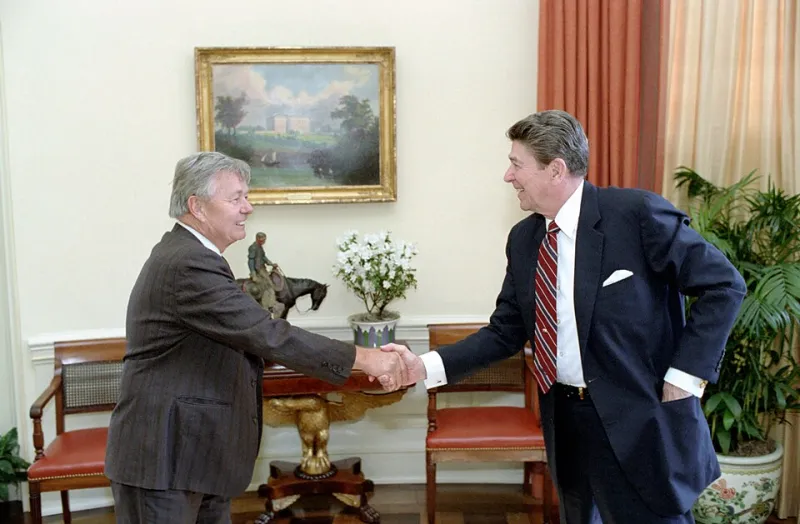
Photo: President (1981-1989 : Reagan). White House Photographic Office. 1981-1989, Public domain, via Wikimedia Commons
When a coalition of evangelical congregations launched a coordinated push last year to influence state-level legislation on parental rights in education, the faces behind the pulpits were familiar. The faces behind the strategy were not. The campaign's messaging architecture, its targeted digital advertising, its carefully timed press releases — all of it bore the fingerprints of a Washington-based consulting firm whose principals hold no religious affiliation and had, until recently, made their reputations running municipal bond referenda and pharmaceutical lobbying accounts.
This is no longer an anomaly. Across the ideological spectrum of American religious life — from Catholic social-justice networks to Southern Baptist political action committees to mainline Protestant advocacy arms — a quiet but consequential shift is underway. Secular operatives, trained in the mechanics of electoral politics and corporate public affairs, have become indispensable architects of faith-based political strategy. Their influence extends from the framing of legislative testimony to the selection of which policy battles a denomination chooses to fight at all.
The Market for Belief, Managed by Nonbelievers
The demand for professional political counsel within religious organizations has accelerated sharply over the past decade, driven by several converging pressures. Faith communities increasingly compete for legislative attention in an environment saturated with well-funded interest groups. Denominations that once relied on the moral authority of clergy to command a hearing in state capitals and on Capitol Hill have found that authority insufficient on its own. They need opposition research. They need coalition mapping. They need someone who understands how a committee chairman thinks.
Consulting firms have recognized the opportunity. Several boutique operations now market themselves explicitly to religious clients, offering services that range from grassroots mobilization to rapid-response media training. Notably, the principals of these firms frequently describe themselves as religiously unaffiliated or only nominally connected to faith traditions. Their pitch is precisely their outsider competence: they understand power, they understand process, and they can translate a congregation's moral convictions into the language that legislative staffers actually read.
"We don't tell them what to believe," said one senior strategist at a firm that counts three national religious advocacy organizations among its clients, speaking on background because his firm's contracts prohibit public disclosure. "We tell them how to be heard. That's a different skill set entirely, and most faith organizations don't have it in-house."
Authenticity and Its Discontents
The arrangement has generated genuine unease within religious communities, and not only among traditionalists suspicious of outside influence. Progressive faith leaders who have spent years building advocacy infrastructure rooted in congregational discernment — the idea that policy positions should emerge organically from the lived experience of worshippers — express concern that professionalized strategy inverts that process. When a consultant recommends that a social-justice coalition emphasize economic framing over theological language because polling data suggests it performs better with swing-district legislators, whose priorities are actually being served?
The Reverend Dr. Constance Harwell, who directs public policy engagement for a mid-sized mainline denomination headquartered in the Mid-Atlantic, put the tension plainly in a recent interview. "There is a version of this that is entirely legitimate," she said. "You hire someone who knows how the sausage is made. Fine. But there is another version where the consultant is effectively deciding what your community cares about, because they've decided what's winnable. That's a theological problem dressed up as a tactical one."
The concern is not hypothetical. Several religious advocacy veterans describe instances in which consulting firms steered clients away from issue areas — criminal justice reform, debt relief, immigration — because internal polling suggested those causes lacked sufficient mobilizing power among the organization's donor base. In at least two cases, according to individuals with direct knowledge of the discussions, the reorientation represented a meaningful departure from positions the denomination had held publicly for years.
Data, Targeting, and the Congregation as Constituency
Perhaps the most striking dimension of secular operatives' influence is their introduction of sophisticated data infrastructure into organizations that once tracked their political engagement through phone trees and bulletin-board announcements. Voter file matching, micro-targeting by zip code and worship attendance patterns, sentiment analysis of social media conversations within faith communities — these tools, standard equipment in modern electoral campaigns, are now being deployed by religious advocacy organizations with increasing regularity.
The implications are significant. When a Catholic advocacy network can identify, with considerable precision, which parishioners in a swing congressional district attended Mass regularly during a bishop's pastoral letter campaign and cross-reference that data with their voting history, the organization is no longer simply bearing witness. It is operating as a political machine, one whose mechanics would be familiar to any campaign manager but might unsettle many of the parishioners whose data is being processed.
Proponents argue that the sophistication is simply necessary. "The groups on the other side of our issues have been doing this for twenty years," said one advocacy director at a national faith-based policy organization, who requested anonymity to speak candidly. "We were bringing a bulletin board to a data fight. That's not righteousness. That's just losing."
The Question of Accountability
For observers of religion and politics, the deeper issue may be one of institutional accountability. Religious organizations derive a particular form of public trust — and, in many cases, favorable tax treatment — from their identity as communities of genuine belief rather than interest groups in clerical dress. When the strategic direction of those organizations is substantially shaped by professionals whose relationship to the faith tradition is purely contractual, questions arise about whether that trust remains warranted.
Legal scholars have begun to examine whether the involvement of secular political consultants in the core advocacy activities of religious nonprofits creates compliance risks under existing IRS guidelines governing political activity by tax-exempt organizations. The analysis is unsettled, partly because the consultants themselves are careful to frame their work as issue advocacy rather than electoral intervention — a distinction that, in practice, can be difficult to maintain.
Congregants, meanwhile, are rarely informed of these arrangements. The consultant's role is seldom disclosed in denominational communications, and the strategies they design are presented to members as expressions of the community's shared convictions rather than as the product of a retainer agreement.
Pragmatism or Proxy?
The debate over secular operatives in religious advocacy ultimately reflects a broader contest over the soul of faith-based political engagement in America. One school of thought holds that religious communities are entitled, even obligated, to pursue their policy goals by whatever legitimate means are available — that hiring a skilled strategist is no different from hiring a skilled attorney or accountant. Another argues that the means are inseparable from the message: that a faith community which outsources its political imagination to hired professionals has, in a meaningful sense, outsourced its prophetic voice.
What is clear is that the phenomenon is growing, that it is reshaping the landscape of religious advocacy in ways that most Americans — including most churchgoers — do not fully perceive, and that the organizations most aggressively embracing professional political management are, by most measurable indicators, also the most effective at achieving their legislative objectives.
Whether effectiveness of that kind is what faith communities should be optimizing for is a question that no consultant is positioned to answer. It remains, stubbornly, a theological one.