Common Cause, Uncommon Allies: The Rise of Interfaith Lobbying in the American Capital
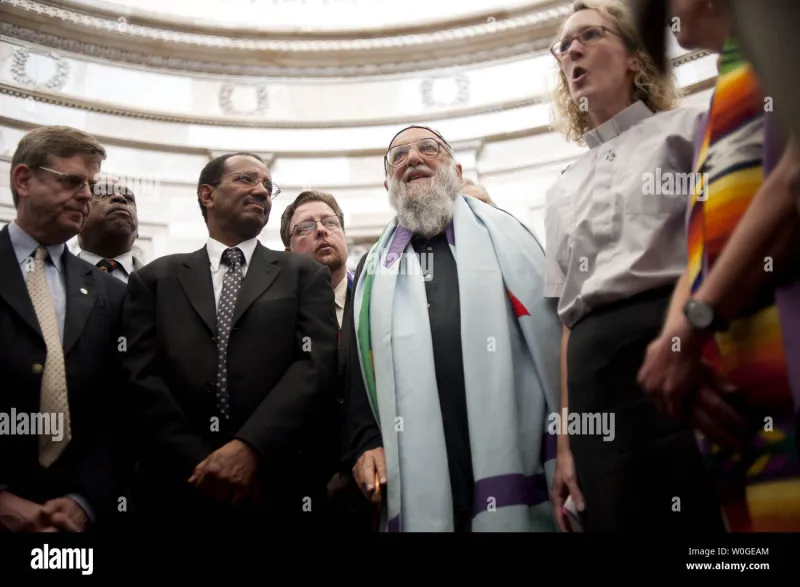
Photo: diverse religious leaders meeting Capitol Hill Washington DC interfaith, via c8.alamy.com
On a Tuesday morning last spring, representatives from the United States Conference of Catholic Bishops, the National Association of Evangelicals, the Jewish Federations of North America, and the Muslim Public Affairs Council gathered in a Senate conference room to present a unified statement on refugee resettlement policy. The meeting drew little press coverage. Yet what unfolded in that room—a formal, coordinated lobbying effort by faith communities that, on many other policy fronts, remain deeply at odds—illustrated a structural shift in how religion engages American politics.
Interfaith political coalitions are no longer a curiosity. They are becoming an instrument of genuine legislative influence, and Washington's policy class is beginning to take notice.
The Architecture of an Unusual Alliance
For decades, the dominant narrative of religious political engagement in the United States was one of division: culture-war battles over abortion, same-sex marriage, and school prayer that sorted faith communities into partisan camps with predictable reliability. Evangelical Protestants aligned closely with the Republican Party; mainline Protestants and many Jewish organizations leaned Democratic; Muslim Americans, after a period of political ambivalence following September 11, tilted increasingly toward Democratic candidates.
Yet that sorting, however durable on social issues, has never been total. On questions of poverty relief, foreign aid, anti-trafficking legislation, and immigration—particularly refugee admissions—distinct religious traditions have found themselves arriving at similar policy conclusions through markedly different theological routes.
The result is a lobbying architecture that cuts across the usual denominational and partisan fault lines. Organizations such as the Faith & Politics Institute, the National Interreligious Leadership Initiative, and the newer Shoulder to Shoulder Campaign have formalized what were once ad hoc collaborations into standing coalitions with shared staff, coordinated congressional testimony, and joint press operations.
"What we have learned," said one senior policy director at a Washington-based interfaith advocacy organization who requested anonymity to speak candidly, "is that a senator who might dismiss a single denomination's position as parochial is considerably harder to ignore when four or five major faith traditions arrive at his door with the same ask."
Where the Coalitions Form—and Where They Fracture
The policy terrain on which interfaith coalitions have proven most durable tends to share a particular characteristic: it is humanitarian rather than doctrinal. Legislation addressing global hunger, domestic anti-poverty programs, human trafficking, and the treatment of asylum seekers at the southern border has repeatedly attracted cross-traditional support in ways that debates over reproductive rights or religious liberty exemptions have not.
The distinction matters. When evangelical groups, Catholic social service networks, Jewish advocacy organizations, and Muslim civil rights groups aligned in opposition to the Trump administration's 2017 refugee executive orders, each brought its own scriptural rationale—whether drawn from the New Testament, Catholic social teaching, the concept of tikkun olam, or the Quranic injunction toward hospitality. The policy conclusion was identical; the theological pathway was not.
That divergence in reasoning, analysts note, is precisely what makes such coalitions structurally fragile. When the policy terrain shifts toward issues that carry explicit theological content—definitions of marriage, abortion access, the scope of religious exemptions in civil rights law—the same organizations that coordinated on refugee policy frequently find themselves in direct opposition.
The United States Conference of Catholic Bishops and major Jewish advocacy organizations, for instance, have collaborated meaningfully on anti-poverty legislation while maintaining fundamental disagreements on reproductive health policy. The National Association of Evangelicals and the Muslim Public Affairs Council have found common ground on foreign aid priorities while diverging sharply on domestic civil liberties questions.
Strategic Calculation or Genuine Convergence?
Critics of the interfaith coalition model raise a pointed question: to what extent do these alliances represent authentic shared values, and to what extent are they instruments of political convenience—deployed when useful, dissolved when inconvenient?
The answer, according to scholars who study religious political behavior, is almost certainly both, and the distinction may matter less than it initially appears.
"Every political coalition involves calculation," observed one political scientist who has published extensively on religion and American public life. "The more relevant question is whether the collaboration produces durable institutional relationships and policy outcomes, or whether it's purely transactional. The evidence on interfaith lobbying suggests it's increasingly the former."
There is measurable evidence for that assessment. The Fairness for All Act, a legislative proposal seeking to balance LGBTQ nondiscrimination protections with religious liberty accommodations, has attracted support from both the Council for Christian Colleges and Universities and certain Jewish organizational voices—a pairing that would have seemed implausible a decade ago. The collaboration has not resolved the underlying theological tensions, but it has produced a sustained, if contested, policy conversation.
Similarly, the Reach Every Mother and Child Act, a global health initiative, has drawn coordinated advocacy from evangelical development organizations and secular Jewish humanitarian groups, demonstrating that operational cooperation can outlast doctrinal disagreement.
Tensions Within Traditions
The formation of interfaith coalitions does not occur without generating internal friction. When religious organizations enter formal political partnerships with traditions that hold divergent views on core doctrinal questions, they risk alienating members who interpret such alliances as implicit legitimation of those differing beliefs.
Several evangelical advocacy organizations have faced internal criticism for partnering with Catholic or Jewish groups whose positions on reproductive health differ substantially from their own. Catholic dioceses that have collaborated with Muslim organizations on immigration advocacy have encountered pushback from parishioners wary of any appearance of theological equivalence.
"There is a real pastoral challenge," acknowledged one faith-based policy director. "You have to explain to your community that working alongside another tradition on a shared policy goal does not mean endorsing everything that tradition teaches. That distinction is not always easy to communicate in a polarized media environment."
For Muslim advocacy organizations, the challenge carries an additional dimension. Partnerships with evangelical or Catholic groups—traditions that have, at various points, supported policies perceived as targeting Muslim communities—require a careful navigation of institutional memory alongside present-day political pragmatism.
A Shifting Center of Gravity
What the growth of interfaith lobbying ultimately reveals is that the relationship between religious conviction and political action in the United States is more complex, and more fluid, than the culture-war framework suggests. The partisan sorting of faith communities is real, but it is not total, and on a meaningful range of policy questions, the lines of religious political engagement do not map cleanly onto the lines of partisan identity.
For lawmakers and their staff, the practical implication is significant. A coordinated interfaith coalition—one that can credibly claim to represent constituencies spanning evangelical megachurches in the South, Catholic dioceses in the Midwest, Jewish federations in the Northeast, and Muslim community organizations in Dearborn and Minneapolis—commands a different kind of political attention than any single tradition can generate alone.
Whether that collective influence translates into durable legislative outcomes remains an open question. Washington has a long memory for coalitions that dissolve under pressure, and the fault lines within interfaith alliances are not difficult to find. But the infrastructure being built—the shared staff, the joint testimony, the coordinated messaging—suggests that these partnerships are being constructed for the long term.
In a capital increasingly defined by entrenched partisan identity, the interfaith lobby represents something genuinely unusual: a political force that defies easy categorization. Whether that defiance proves to be a strategic asset or an organizational liability may well determine how consequential these coalitions become in the decade ahead.