The Congregation Speaks: Why Evangelical Voters Are Quietly Departing the Agenda Their Leaders Set
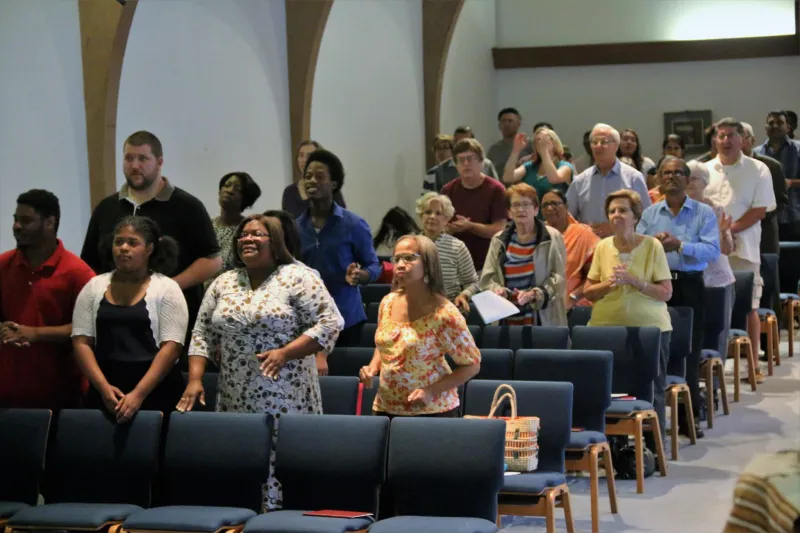
Photo: diverse church congregation worship service evangelical community, via www.resourceumc.org
For the better part of four decades, white evangelical Christianity functioned as one of the most reliable and coherent voting blocs in American electoral politics. Exit polls, precinct-level data, and denominational surveys told a consistent story: when prominent evangelical leaders spoke, their congregants followed — at the ballot box if not always in the pew. That story is becoming harder to tell.
A convergence of survey research published over the past three years paints a more complicated picture, one in which the gap between what evangelical institutions publicly advocate and what individual evangelical voters actually believe has widened into something that researchers are beginning to describe not as a gap but as a fracture.
What the Numbers Show
The Public Religion Research Institute's 2023 American Values Survey found that white evangelical Protestants under the age of 45 hold measurably different views from their older counterparts on several policy questions that their denominational leadership has treated as settled. On immigration, 41 percent of younger white evangelicals expressed support for pathways to legal status for undocumented immigrants — a position that places them closer to the median American voter than to the restrictionist stance advocated by many high-profile evangelical political organizations.
The divergence is more pronounced on environmental policy. While the leadership of major evangelical institutions has historically resisted climate legislation — often framing environmental regulation as an economic threat or a secular ideological imposition — surveys consistently show that a substantial minority of younger evangelical churchgoers regard care for creation as a theological obligation. A 2022 survey conducted by the Evangelical Environmental Network found that 45 percent of self-identified evangelicals between the ages of 18 and 35 supported significant federal action on climate change, compared with 22 percent of those over 65.
Even on abortion — the issue most closely identified with evangelical political identity — the uniformity that national leaders project is less solid than it appears. Polling conducted following the Supreme Court's 2022 Dobbs decision found that a notable share of self-identified evangelicals supported exceptions for rape, incest, and maternal health that many evangelical advocacy organizations had formally opposed.
Voices from the Pews
The data points acquire texture in conversation. At an evangelical congregation in suburban Columbus, Ohio — a community that voted overwhelmingly Republican in the last three federal election cycles — a 34-year-old Sunday school teacher described a growing discomfort with the political messaging she encounters from national evangelical figures.
"I love my church. I believe what we believe," she said, asking that her name not be used out of concern for her standing in the congregation. "But when I hear leaders talking about immigration like it's purely a law enforcement problem, I think about the families in our congregation who have relatives that came here without documentation. It doesn't feel like the same faith."
A 28-year-old worship leader at a mid-sized evangelical church in suburban Atlanta expressed similar ambivalence. "My parents' generation experienced evangelical political identity as something organic — it came out of their convictions. For a lot of people my age, it feels like the politics came first and the theology got arranged around it afterward. That's a hard sell."
Not every congregant dissents. Older members at both churches described the leadership's political positions as consistent with their own, and several expressed frustration with what they characterized as younger evangelicals' susceptibility to secular cultural pressure. "Every generation thinks it's discovered something the previous one missed," said a retired schoolteacher in her late 60s at the Columbus church. "I've seen this before. They'll come around."
The Leadership Perspective
Senior pastors and denominational officials who spoke with Religious Intelligence largely acknowledged the generational tension, though they differed in how they characterized its significance. Several argued that polling data captures momentary opinion rather than deeply held conviction, and that younger evangelicals who feel cultural discomfort with conservative political positions often return to traditional stances as they age, marry, and raise children.
Others were more candid about the challenge. One senior pastor at a congregation of approximately 4,000 in the Dallas-Fort Worth area, who agreed to speak on background, acknowledged that his church had deliberately reduced the frequency of explicitly political messaging from the pulpit over the past two years. "We were losing people," he said simply. "Not because they disagreed with us on the core theological questions, but because they felt like the church had become a subsidiary of a political party. That's not a sustainable position."
The concern about institutional credibility surfaced repeatedly in conversations with evangelical leaders. Several referenced surveys showing declining church attendance among Americans under 40 and expressed worry that an overly rigid identification with one political coalition could accelerate disaffiliation among younger members who feel politically alienated.
Generational Arithmetic and Demographic Pressure
The demographic mathematics underlying these shifts deserve attention. White evangelical Christians represented approximately 23 percent of the American adult population in 2006, according to PRRI. By 2023, that figure had declined to roughly 13 percent. The decline reflects both generational replacement — younger Americans are less likely to identify with any religious tradition — and the specific phenomenon researchers call "political disaffiliation," in which individuals leave religious communities partly in response to perceived political pressure.
Simultaneously, the evangelical community itself is becoming more racially diverse, a shift that carries significant political implications. Hispanic evangelical Christians, a growing share of the broader evangelical population, hold markedly different views on immigration than their white counterparts and vote in more varied patterns. As their numerical weight within evangelical institutions increases, the political coalition that national leaders have constructed faces pressure from within its own expanding membership.
A Movement at a Crossroads
What emerges from the data and the conversations is a portrait of a movement whose institutional leadership and rank-and-file membership are increasingly operating from different maps. The leaders see a coherent political theology refined over decades of engagement with American public life. Many congregants — particularly younger ones — see a set of political commitments that feel contingent, culturally specific, and in some cases in tension with the gospel they understand themselves to be living.
Whether that tension resolves through institutional adaptation, continued disaffiliation, or the emergence of alternative evangelical political identities remains genuinely uncertain. What is less uncertain is that the era in which evangelical leaders could speak for their congregations with confidence on the full range of contested political questions appears to be ending — not with a declaration, but with a quiet, persistent divergence that is showing up in poll after poll, and in conversations happening in church parking lots across the country.