The Ground Game of God: How Religious Networks Are Quietly Deciding Swing State Elections
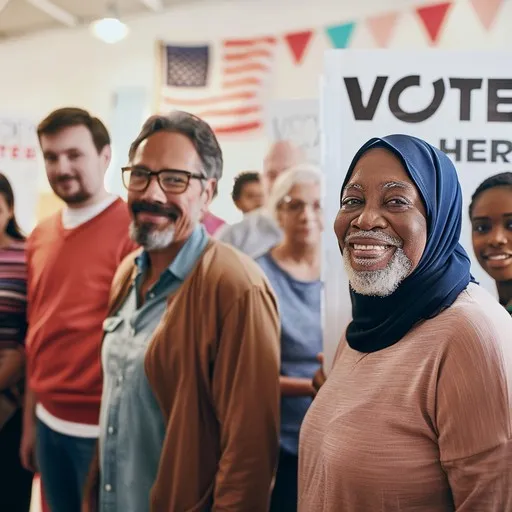
Photo: diverse congregation community meeting civic engagement voting, via images.stockcake.com
On a Tuesday evening in late September, the fellowship hall of a mid-sized Baptist congregation in suburban Atlanta held what its bulletin described as a "civic engagement workshop." Folding tables were arranged in clusters. Laptops were open. Volunteers—most of them church members, some affiliated with a national faith-based advocacy organization—walked attendees through the mechanics of absentee ballot requests, early voting schedules, and precinct-level turnout data.
The meeting was not a campaign event in any legal sense. No candidate was endorsed. No party literature was distributed. But the underlying architecture—the lists, the precinct maps, the follow-up protocols—was indistinguishable from what a professional political operation would deploy. The only difference was the venue and the network that had assembled the room.
This is the ground game of 2024: sophisticated, data-informed, legally careful, and increasingly anchored in the physical and social infrastructure of American religious life.
The Strategic Logic of Sacred Space
Political operatives on both sides of the ideological spectrum have long understood that churches, mosques, synagogues, and temples offer something that conventional campaign offices cannot easily replicate: pre-existing communities of trust, regular convening rhythms, and leaders whose authority is relational rather than transactional.
What has changed in recent cycles is the degree of intentionality with which these assets are being mapped and activated. Organizations on the religious right—including the Faith & Freedom Coalition, the Family Research Council's political arm, and a newer generation of evangelical civic organizations—have spent years building what they describe as "church-based precinct strategies," identifying congregation members who live in competitive precincts and training them as neighborhood-level advocates.
The approach is mirrored, with different theological inflections, on the religious left and center. Groups such as Faith in Action, Sojourners' advocacy network, and the Poor People's Campaign have constructed parallel infrastructure in swing states, often working through Black Protestant churches, Latino Catholic parishes, and progressive mainline congregations that have historically served as anchors of Democratic-leaning civic participation.
"The congregation is the most underutilized organizing unit in American politics," said the national field director of a faith-based voter mobilization nonprofit, speaking on background. "It has geographic density, it has relational trust, and it meets every week. No campaign can build that from scratch. You either plug into it or you don't."
Michigan: The Interfaith Battleground
Few states illustrate the complexity of faith-based political mobilization more vividly than Michigan, where the 2024 electoral landscape has been shaped by an interfaith fracture that neither party fully anticipated.
Michigan's Arab American and Muslim communities—concentrated in Dearborn, Dearborn Heights, and surrounding Wayne County suburbs—had been reliable components of the Democratic coalition for decades. But the war in Gaza, and the Biden administration's posture toward it, produced an organized campaign of electoral dissent that was explicitly framed in religious terms. Mosque leaders who had previously hosted voter registration drives for Democratic candidates instead convened community forums on the ethics of political participation, with several prominent imams publicly endorsing the "uncommitted" primary campaign as a form of religiously grounded protest.
The fracture created an opening that conservative faith organizations attempted to exploit, dispatching outreach teams to Arab American communities with messaging that foregrounded shared social conservative values on questions of family structure and religious expression in public life. The effort yielded mixed results but demonstrated the degree to which faith-community loyalty is no longer a fixed variable in swing-state calculations.
Meanwhile, in western Michigan, the Dutch Reformed and broader evangelical communities that anchor the Republican coalition in that region have been the subject of intensive mobilization by organizations coordinating through the state's network of Christian schools and homeschool associations—institutions that, like congregations, provide ready-made community infrastructure.
Pennsylvania: The Catholic Pivot
In Pennsylvania, the competitive suburban counties surrounding Philadelphia have become a laboratory for competing Catholic political strategies. The Archdiocese of Philadelphia has been careful to maintain institutional neutrality on candidate preferences while issuing detailed voter guides that prioritize abortion, religious liberty, and poverty as the primary lenses through which Catholics should evaluate candidates—a framing that, critics argue, structurally advantages one party over the other.
Independent Catholic advocacy organizations have been less restrained. Catholics for Choice has run paid advertising in Philadelphia's collar counties, explicitly challenging the archdiocese's framing and arguing that Catholic social teaching supports a broader range of policy positions than the bishops' voter guides acknowledge. The intra-Catholic public argument—unusual in its directness—reflects a broader reality: that the Catholic vote, long treated as a coherent bloc, is now a genuinely contested terrain.
Pastoral leaders in Allegheny County, meanwhile, describe a congregation-level phenomenon in which political discussions that once occurred outside church walls have migrated inward, creating pastoral challenges that many clergy feel ill-equipped to navigate.
Arizona and Nevada: The New Evangelical Geography
In the Sun Belt's competitive states, the growth of Latino evangelical congregations has introduced a constituency that defies easy partisan categorization. Predominantly Pentecostal and charismatic in their worship traditions, these communities tend toward social conservatism on questions of gender and sexuality while holding economic and immigration views that align more closely with Democratic priorities.
Both parties have invested in outreach to these congregations, with varying degrees of cultural fluency. Republican-aligned organizations have emphasized religious liberty and opposition to abortion; Democratic-aligned groups have stressed immigration policy and economic justice, often working through labor-affiliated faith coalitions.
National evangelical organizations have identified Latino Pentecostal pastors as a priority recruitment target for their precinct-level programs, offering training resources and civic engagement toolkits translated into Spanish. The effort is still maturing, but organizers on both sides describe it as one of the most significant emerging variables in southwestern swing-state politics.
The Question of Institutional Risk
For religious leaders navigating this landscape, the political intensity of the 2024 cycle has sharpened a perennial tension: the desire to fulfill what many understand as a prophetic civic obligation against the risk of subordinating pastoral identity to partisan purpose.
Several clergy members interviewed for this article described congregants who had left their communities over political disagreements, or who had explicitly sought out congregations whose political orientations matched their own—a sorting process that reinforces the tendency of religious institutions to function as partisan rather than pluralistic civic spaces.
The legal framework governing church political activity—centered on the Johnson Amendment's prohibition on explicit candidate endorsements by tax-exempt organizations—has done little to constrain the mobilization described here, since the most effective faith-based political organizing operates well within those boundaries. What it cannot do is resolve the deeper institutional question: whether the deliberate instrumentalization of religious community for electoral ends ultimately serves or undermines the institutions being leveraged.
That question, for now, remains unanswered—and largely unasked—in the fellowship halls and mosque meeting rooms where the ground game of 2024 is being quietly decided.