Shadow Giving: The Invisible Architecture of Megachurch Political Finance

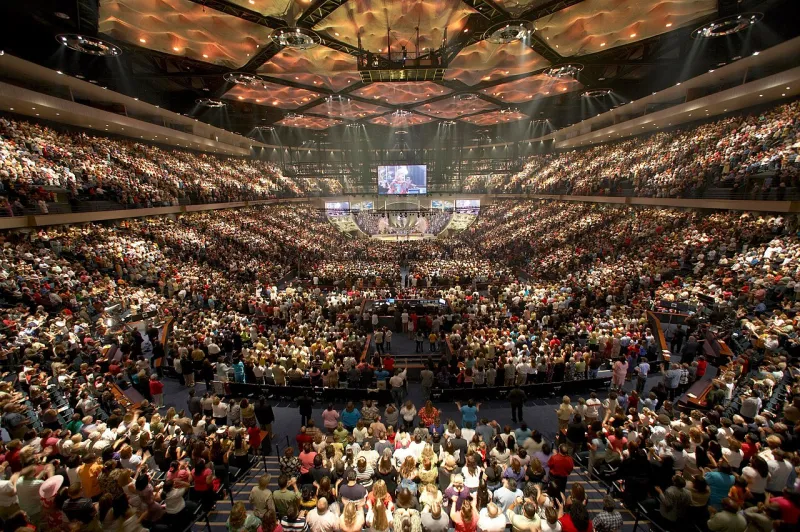
Photo: Nheyob, CC BY-SA 4.0, via Wikimedia Commons
When a major piece of legislation clears a congressional committee, the names of its most consequential backers rarely appear in the public record. Lobbyists are disclosed. Corporate PAC contributions are filed. But a third category of political actor — the faith-affiliated donor network operating through layers of nonprofit and advocacy structures — frequently escapes the transparency requirements that govern more conventional political spending. For researchers, journalists, and watchdog organizations attempting to trace the origins of policy outcomes, this gap is not incidental. It is, in many cases, by design.
The financial architecture that connects America's wealthiest religious institutions to national political outcomes has grown considerably more sophisticated over the past two decades. What began as informal giving among congregants who shared political convictions has matured into a coordinated system of intermediary organizations, donor-advised funds, and issue-advocacy nonprofits that collectively move hundreds of millions of dollars each election cycle — much of it without any public disclosure requirement.
The 501(c)(4) Gateway
At the center of this system sits the 501(c)(4) social welfare organization, a legal designation that permits unlimited political spending on issue advocacy without mandatory donor disclosure. Unlike traditional political action committees, which must report their contributors to the Federal Election Commission, 501(c)(4) groups are required only to demonstrate that their primary purpose is social welfare rather than electoral activity — a standard that has proven elastic enough to accommodate a wide range of politically consequential work.
Faith-aligned 501(c)(4) organizations have proliferated substantially since the Supreme Court's 2010 decision in Citizens United v. Federal Election Commission, which affirmed the right of nonprofit corporations to spend freely on independent political expenditures. In the years following that ruling, a number of prominent megachurch networks and their affiliated leadership established or dramatically expanded issue-advocacy organizations operating under religious or values-oriented branding. These entities fund voter mobilization, candidate education campaigns, and legislative lobbying efforts — activities that, taken together, constitute a formidable political operation, but that individually satisfy the legal threshold for social welfare classification.
The practical consequence is a form of donor anonymity that has no equivalent in conventional campaign finance. A congregant who writes a seven-figure check to a faith-aligned 501(c)(4) appears nowhere in any public filing. The organization receiving those funds may in turn contribute to other nonprofits, further obscuring the origin of the capital before it ultimately finances a policy campaign, a ballot initiative, or an issue-advocacy blitz targeting a competitive congressional district.
Tracing the Policy Footprint
Despite the opacity of the system, researchers have identified recurring patterns that illuminate how coordinated religious giving translates into concrete policy outcomes. Investigative work by campaign finance watchdogs and academic institutions has documented instances in which legislative pushes on issues including religious liberty protections, abortion access restrictions, and school choice funding initiatives were preceded by concentrated giving activity among networks of faith-aligned donors — activity that, when examined across multiple filing periods and jurisdictions, reveals a degree of coordination inconsistent with spontaneous civic engagement.
Consider the legislative history of conscience protection measures at the state level over the past decade. In several states where such measures advanced from introduction to passage within compressed timeframes, post-enactment analysis revealed that the advocacy organizations most active in lobbying for their passage had received significant funding from a small number of faith-affiliated donor networks in the preceding fiscal years. The individual grants were structured in amounts and to entities that did not trigger public disclosure. The policy outcome, however, was unmistakable.
Similar patterns have emerged in the context of federal judicial nominations, where faith-aligned advocacy organizations have played a documented role in mobilizing public support for nominees whose jurisprudence aligned with conservative religious values. The financial underpinning of those campaigns — who funded the advertising, who paid for the grassroots mobilization infrastructure — has in most cases remained opaque.
The Donor-Advised Fund Layer
Complicating the picture further is the growing use of donor-advised funds, or DAFs, as an intermediate vehicle in faith-aligned political giving. A donor-advised fund allows an individual or family to make a charitable contribution, receive an immediate tax deduction, and then direct grants from the fund to qualifying organizations over time. Because DAFs are administered by sponsoring organizations — many of them affiliated with community foundations or, increasingly, with explicitly faith-based financial institutions — the original donor's identity is effectively laundered from the public record by the time funds reach an advocacy organization.
Several large DAF sponsors with explicit religious missions have grown rapidly in assets under management over the past decade, a trajectory that coincides with the expansion of faith-aligned political spending. While the majority of funds flowing through these vehicles undoubtedly support genuinely charitable purposes, the same infrastructure is available for grants to 501(c)(4) organizations engaged in political advocacy — and the same disclosure exemptions apply.
The Question of Accountability
None of this activity is necessarily illegal. The structures through which faith-aligned political money flows were created by Congress and upheld by federal courts. Religious organizations enjoy constitutional protections that complicate regulatory intervention, and the line between protected religious expression and taxable political activity has historically been drawn with considerable deference to faith institutions.
But legality and accountability are distinct questions. The Internal Revenue Code prohibits 501(c)(3) organizations — including most churches — from directly intervening in electoral campaigns on behalf of candidates. This restriction, known as the Johnson Amendment, has never been robustly enforced, and periodic legislative efforts to repeal it entirely have drawn strong support from faith-affiliated political networks. Critics argue that lax enforcement of existing rules, combined with the structural opacity of 501(c)(4) and DAF vehicles, has created a de facto system of unaccountable political finance operating under religious cover.
Proponents of the current framework counter that transparency requirements imposed on faith-affiliated donors would chill constitutionally protected religious expression and expose contributors to harassment. This argument has found receptive audiences in federal courts, which have in recent years imposed heightened scrutiny on state-level donor disclosure requirements.
What Transparency Would Reveal
The most significant consequence of the current opacity may be less about any individual policy outcome than about the aggregate distortion of democratic deliberation. When a legislative priority advances with the apparent support of a broad civic coalition, but the financial infrastructure driving that coalition traces back to a small number of wealthy religious donors whose identities are never publicly disclosed, the public's ability to evaluate the true origins and interests behind policy proposals is fundamentally compromised.
Reform advocates have proposed a range of remedies, from expanded disclosure requirements for 501(c)(4) political spending to tighter IRS enforcement of the existing prohibition on church electioneering. Each proposal faces significant legal and political obstacles. What is not in dispute is that the current system permits a degree of religious political influence that is both substantial in scale and largely invisible in operation — a combination that raises questions that transcend partisan affiliation and speak directly to the integrity of American democratic institutions.