Steeples and Strip Malls: How Megachurches Are Quietly Becoming the Most Powerful Landowners in American Cities
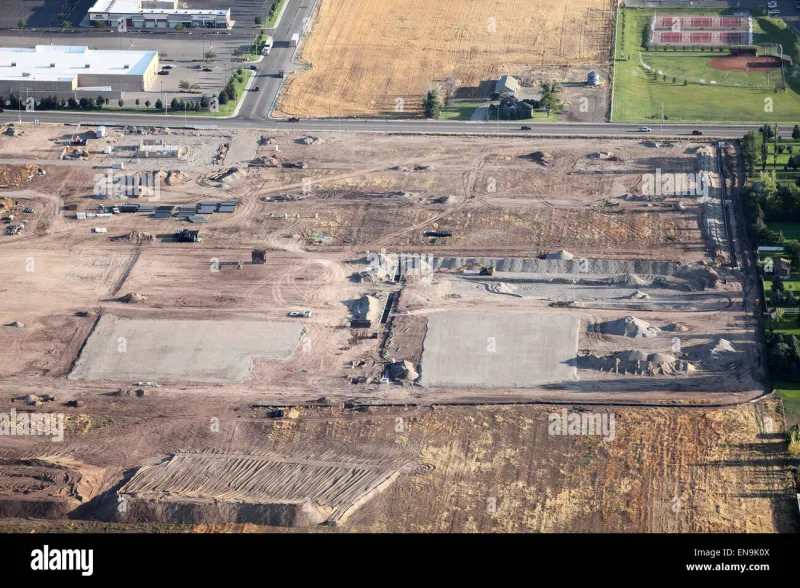
Photo: megachurch building commercial real estate development aerial view, via c8.alamy.com
On the surface, the transaction looked unremarkable: a religious nonprofit acquiring a former big-box retail property on the outskirts of a mid-sized Southern city. But within eighteen months of the purchase, the congregation had successfully lobbied the municipal planning commission to rezone adjacent parcels, secured a tax abatement typically reserved for affordable housing developers, and installed a senior church official on a newly formed community development advisory board. The property is now the anchor of a mixed-use campus that generates millions in annual revenue—none of it subject to federal income tax.
This pattern, replicated with striking consistency across dozens of American cities, represents one of the more consequential and least scrutinized transformations in the relationship between religious institutions and local political power. Megachurches—broadly defined as Protestant congregations with weekly attendance exceeding two thousand—have become significant commercial real estate actors. And as their property portfolios expand, so too does their capacity to shape the political environments in which they operate.
From Worship Space to Real Estate Empire
The theological rationale for institutional expansion varies by denomination and pastoral philosophy. Some church leaders frame property acquisition as stewardship—a biblical imperative to multiply resources in service of community mission. Others speak plainly about financial sustainability, noting that diversified real estate income insulates congregations from the volatility of weekly tithing. A growing cohort of megachurch administrators has adopted the language of urban development outright, hiring commercial property managers, retaining real estate attorneys, and engaging municipal planners as routine partners.
The scale of this expansion can be difficult to quantify, in part because religious organizations are not required to disclose real estate holdings with the same transparency demanded of publicly traded entities or even many nonprofits. However, property records, municipal planning documents, and court filings reviewed by Religious Intelligence reveal a consistent trend: large faith institutions in metropolitan areas across Texas, Florida, Georgia, Tennessee, and the Carolinas have assembled property portfolios that extend well beyond worship facilities into income-generating commercial ventures.
In suburban Atlanta, one congregation controls a portfolio that includes a 200-unit apartment complex, a licensed childcare center operating across three campuses, and a co-working facility marketed to local businesses. In the Dallas-Fort Worth corridor, a megachurch with more than fifteen thousand weekly attendees owns a retail strip center and has entered into a development agreement with a national homebuilder for a residential subdivision on church-owned land. In Central Florida, a faith-based organization has leveraged its property holdings to anchor a broader redevelopment district, with church-affiliated entities serving on the governing board that allocates public infrastructure funds.
The Zoning Lever
Property ownership, in the American municipal context, is rarely a passive condition. It confers standing in planning proceedings, access to elected officials, and leverage in negotiations over public services and infrastructure investment. For megachurches, whose congregations often include local attorneys, developers, elected officials, and planning commissioners among their membership, this leverage can be considerable.
Zoning battles have emerged as a particularly visible arena. Religious institutions enjoy certain federal protections under the Religious Land Use and Institutionalized Persons Act of 2000, which limits the ability of local governments to apply land-use regulations in ways that impose a substantial burden on religious exercise. Megachurches have become increasingly sophisticated in deploying this statute—not merely to protect existing sanctuaries, but to facilitate broader campus expansions that include commercial and residential components. Legal advocates for local governments report that the line between protected religious use and commercial development has grown increasingly contested in RLUIPA litigation.
Beyond litigation, the political dimension of these disputes is often more subtle. Elected officials in smaller municipalities frequently depend on megachurch networks for volunteer infrastructure, voter mobilization, and campaign contributions. When a congregation with five thousand households seeks a variance or a rezoning approval, the political calculus facing a city council member can be acute. Several municipal officials interviewed for this article described receiving explicit or implicit signals that a congregation's civic cooperation—including its participation in city-sponsored community programs—was contingent on favorable treatment in land-use proceedings.
Community Development as Political Currency
Perhaps the most sophisticated dimension of megachurch real estate strategy involves the deliberate alignment of property development with public policy priorities. By positioning their holdings as instruments of affordable housing provision, economic revitalization, or social service delivery, large faith institutions have secured a seat at tables previously reserved for municipal agencies and established nonprofit developers.
Federal and state programs designed to incentivize community investment—including New Markets Tax Credits, Opportunity Zone designations, and Community Development Block Grant funding—have increasingly flowed toward faith-adjacent entities. In some cases, religious organizations have structured their real estate holdings through affiliated nonprofit subsidiaries to access these programs while maintaining operational control.
This arrangement generates genuine community benefit in many instances. Church-affiliated affordable housing projects have filled gaps left by retreating public housing agencies in several cities. Faith-based childcare facilities operate in neighborhoods underserved by commercial providers. The policy question is not whether these contributions are real, but whether the political relationships they cultivate—and the regulatory deference they tend to produce—are being adequately examined by the public officials and journalists responsible for accountability.
A Regulatory Blind Spot
The opacity surrounding religious real estate is, in significant part, a function of law. Churches and religious organizations are exempt from filing the Form 990 public disclosure returns required of most nonprofits, meaning that their financial activities—including real estate transactions, development agreements, and revenue from commercial properties—are largely invisible to the public. State-level disclosure requirements vary widely and are rarely enforced with rigor.
Legal scholars and good-government advocates have periodically called for reform, arguing that the scale and commercial character of large religious real estate operations has long since outpaced the assumptions underlying the exemption framework. Those efforts have consistently foundered against the combined political resistance of religious liberty advocates and faith communities that span the ideological spectrum.
For now, the information asymmetry between these institutions and the public officials nominally responsible for regulating their activities remains substantial. Municipal planners, in interviews conducted for this article, frequently acknowledged that they lacked the resources or the political support to scrutinize megachurch development proposals with the rigor applied to secular commercial applicants.
Faith, Land, and Democratic Accountability
The emergence of large faith institutions as major property actors raises questions that are not easily resolved within existing frameworks of religious freedom jurisprudence or nonprofit regulation. The political influence that flows from real estate ownership—access, leverage, and the capacity to shape the built environment of American communities—is not inherently illegitimate. Secular landowners exercise the same influence routinely.
What distinguishes the megachurch case is the combination of tax privilege, disclosure exemption, and constitutional protection that insulates these institutions from the accountability mechanisms applied to other significant political actors. When a church that pays no property tax on a mixed-use development campus also shapes the zoning code governing its competitors, the public interest questions are genuine and pressing.
Religious Intelligence will continue examining the specific mechanisms through which faith-based real estate portfolios translate into political outcomes at the municipal level. The story of how American congregations became major landowners is, at its core, a story about how power accumulates in the spaces where law, faith, and local governance converge—and about who is watching.